


Page 53 - brain-eBook
P. 53
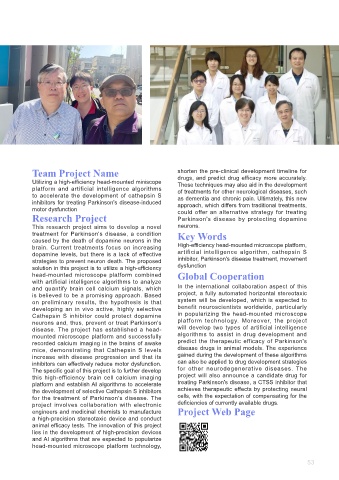
Team Project Name                                  shorten the pre-clinical development timeline for

            Utilizing a high-efficiency head-mounted miniscope   drugs, and predict drug efficacy more accurately.
                                                               These techniques may also aid in the development
            platform and artificial intelligence algorithms    of treatments for other neurological diseases, such
            to accelerate the development of cathepsin S       as dementia and chronic pain. Ultimately, this new
            inhibitors for treating Parkinson's disease-induced   approach, which differs from traditional treatments,
            motor dysfunction                                  could offer an alternative strategy for treating
            Research Project                                   Parkinson's disease  by protecting  dopamine

            This research project aims to develop a novel      neurons.
            treatment for Parkinson's disease, a condition     Key Words
            caused by the death of dopamine neurons in the
            brain. Current treatments focus on increasing      High-efficiency head-mounted microscope platform,
            dopamine levels, but there is a lack of effective   artificial intelligence algorithm, cathepsin S
            strategies to prevent neuron death. The proposed   inhibitor, Parkinson's disease treatment, movement
            solution in this project is to utilize a high-efficiency   dysfunction
            head-mounted microscope platform combined          Global Cooperation
            with artificial intelligence algorithms to analyze
            and quantify brain cell calcium signals, which     In the international collaboration aspect of this
            is believed to be a promising approach. Based      project, a fully automated horizontal stereotaxic
            on preliminary results, the hypothesis is that     system will be developed, which is expected to
            developing an in vivo active, highly selective     benefit neuroscientists worldwide, particularly
            Cathepsin S inhibitor could protect dopamine       in popularizing the head-mounted microscope
            neurons and, thus, prevent or treat Parkinson's    platform  technology.  Moreover,  the  project
            disease. The project has established a head-       will develop two types of artificial intelligence
            mounted microscope platform and successfully       algorithms to assist in drug development and
            recorded calcium imaging in the brains of awake    predict the therapeutic efficacy of Parkinson's
            mice,  demonstrating  that  Cathepsin  S  levels   disease drugs in animal models. The experience
            increase with disease progression and that its     gained during the development of these algorithms
            inhibitors can effectively reduce motor dysfunction.   can also be applied to drug development strategies
            The specific goal of this project is to further develop   for other neurodegenerative diseases.  The
            this high-efficiency brain cell calcium imaging    project will also announce a candidate drug for
            platform and establish AI algorithms to accelerate   treating Parkinson's disease, a CTSS inhibitor that
            the development of selective Cathepsin S inhibitors   achieves therapeutic effects by protecting neural
            for the treatment of Parkinson's disease. The      cells, with the expectation of compensating for the
            project  involves  collaboration  with  electronic   deficiencies of currently available drugs.
            engineers and medicinal chemists to manufacture    Project Web Page
            a high-precision stereotaxic device and conduct
            animal efficacy tests. The innovation of this project
            lies in the development of high-precision devices
            and AI algorithms that are expected to popularize
            head-mounted microscope platform technology,

 52                                                                                                          53

